February 1926, 1998
movies
Julie Christie as Phyllis: Isolating herself from the world with alcohol and irony.
The tragicomic nuances of two marriages gone awry.
Written and Directed by Alan Rudolph
A Sony Pictures Classics Release
recommended
The title of Alan Rudolph's Afterglow is wistfully ironic. The reference is not to rosy postcoital bliss, but to the burned-out luster of a relationship that has run its course. Jonny Lee Miller and Lara Flynn Boyle play Jeffrey and Marianne Byron, whose superficially ideal marriage has run aground over his refusal to have sex with her. With tailored suits and close-cut hair, Jeffrey is a fast-track junior executive obsessed with perfection, the kind who probably keeps The Book of Five Rings in his top desk drawer. Marianne is a slight, perky housewife who bounces around their soullessly modern apartment with little-girl steps, pleading for the attention Jeffrey can only give himself.
When her husband orders her to fix a broken door lock the only flaw in his otherwise perfect apartment Marianne calls on Lucky Mann (Nick Nolte), a bearish, carnally alert contractor whose fix-it business is more of a sideline to his philandering than the other way around. Immediately infatuated with Lucky's rough presence, Marianne prolongs his stay by having him convert a spare room into a nursery, and before long the two are sloshing around in the Byrons' immense hot tub. (The camera pans from Boyle arching her back in ecstasy to Nolte's wet head emerging from under the water, so we can tell he's not just out to please himself.)
Rudolph introduces Lucky like a caricature of the randy workman: a shot of a wrench protruding from between his legs pulls back to reveal a woman's hand caressing a cigar. But there's a poignant side to Lucky's skirt-chasing. Like Jeffrey, Lucky's wife Phyllis (Oscar-nominated Julie Christie) has shut herself off from the passion of their marriage; it's been almost a decade since she and Lucky were intimate. As wide as his wolfish grin is when he walks through Marianne's door, Lucky's really a wounded romantic. He reminisces about the good old days"chocolate cream pies and a six pack of beer" is how he puts itbut Phyllis would rather lacerate her husband for his infidelities (which go on with her tacit consent) than do anything to alter the state of their marriage.
Nolte and Christie
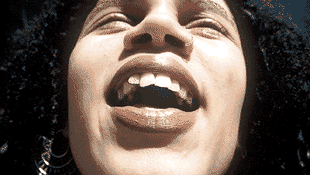
Phyllis is a faded B-movie actress, and as the movie begins, she gets the news that an old co-star and former lover of hers has died. Watching their old movies on TV, she retreats into the past, taking refuge in metaphysical mumblings. (When Lucky asks how her lover died, Phyllis replies, "He was allergic to himself.") She isolates herself from the world with alcohol and irony, not letting any emotion run too deep. It takes a while for us to find out why, but we understand instantly that Phyllis has shut herself away because to feel anything would be to feel too much, to tap a long-sealed reservoir of self-destroying pain. When the dam does finally burst, Phyllis can only howl uncontrollably, powerless to channel years of pent-up desolation.
Phyllis and Jeffrey run into each other in a hotel bar (they've both come to spy on their spouses) and he charms her into accompanying him on a business trip to the country. Their affair doesn't go quite as smoothly as their spouses', though. Phyllis is coldly acerbic at first, and by the time she's started to open herself up to him, Jeffrey has lost interest; he's more interested in proving he can have her than following through with their tryst.
Jeffrey spouts business-book bravado and is fond of jumping up on the ledge outside his office, but ultimately he's as consumed by fear as Phyllis, and as unable to show it. Where Phyllis hides behind sarcasm, Jeffrey adopts the implacable facade of the "true king"; any chink in the armor wouldn't fit with his image. Jonny Lee Miller performs the tricky feat of making a character as unlikable as Jeffrey sympathetic; his soulful, lost eyes let us in on Jeffrey's vulnerabilities. He has his own camera move, too: where the camera glides towards the other characters, Jeffrey is filmed in tight closeup, the camera spinning sideways as if to show his inability to orient himself to the world. (The spinning and Jeffrey's standing on the ledge both seem to link him to Jimmy Stewart's character in Vertigo, who, like Jeffrey, has trouble with sexual potency.)
One of Alan Rudolph's first jobs was as assistant to Robert Altman on Nashville, and without bumping the cast list into triple digits, Afterglow gives you the same feeling of characters adrift in a world they can't understand, and of chance meetings that mean more than relationships years in the making. Rudolph bases his plot on a series of coincidences, and he keeps having the characters almost run into each other, so it's no surprise when the four eventually collide. Unlike the cathartic gunshot which ends Nashville, though, the blowout at the end of Afterglow is almost anticlimactic, an implosion. There's plenty of shouting and carrying-on, but Rudolph stages the scene as a kind of absurd comedy; when the two men start snarling at each other like animals, they're parodying their own masculinity.
It's that weird mixture of tones which most distinguishes Afterglow, the shift from tragedy into farce and back again. (The way he does it, there doesn't seem to be that much distance between the two.) Rudolph doesn't hit every note, but his control is so assured on so many levels that the few misstrikes merely pass out of your mind. The material is heavy, but Rudolph's touch is light; he cuts the scenes short and keeps the camera moving, and that movement is what you cling to.